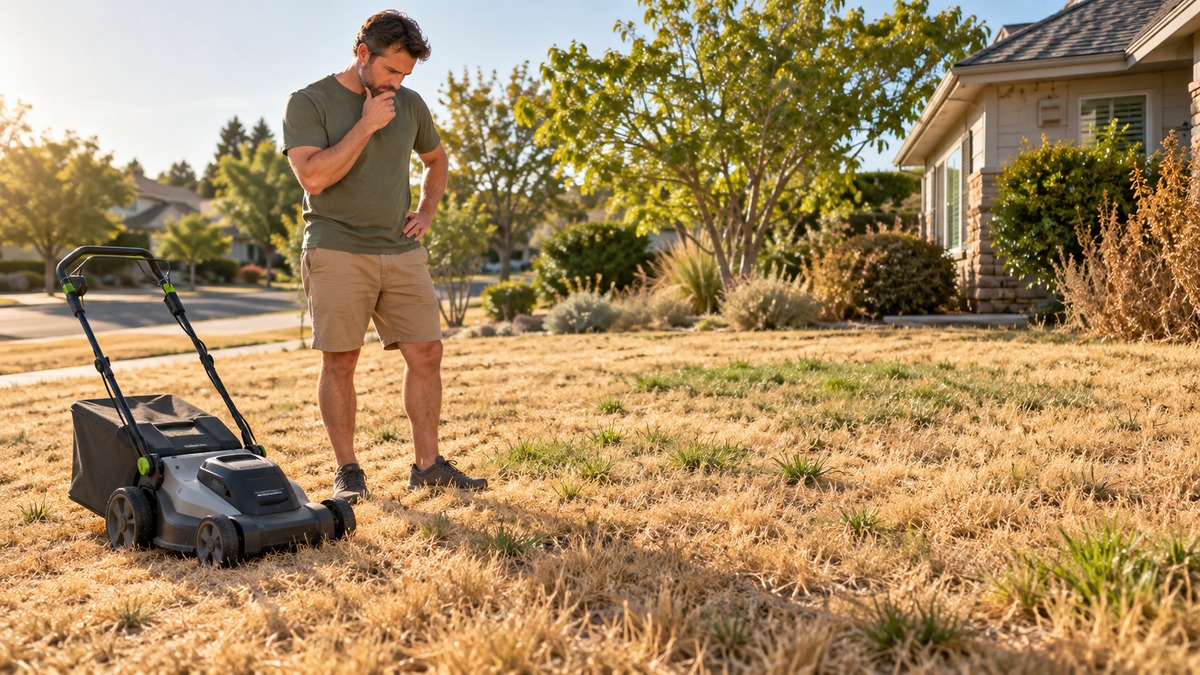
Should You Mow a Lawn During a Drought?
As an Amazon Associate we earn from qualifying purchases.
If you are asking should you mow a lawn during drought, the short answer is that you should do it only with care. Extension sources agree on the main step: raise the deck. They do not agree on the exact height, and only one of them addresses cutting dormant turf directly. This guide sets out what each source says, the reasons behind each figure, and the checks to run before you start the mower.
Quick answer
- Mow a drought-stressed lawn only if you must, and raise the deck. The sources give 2.5 to 4 inches, and two of them give 3.5 inches or higher.
- Do not cut dormant grass short. South Dakota State’s warning about cutting short applies to dormant grass in particular.
- Keep the one-third rule. Mississippi State and South Dakota State both say to remove no more than a third of the grass in one cut.
- Check for drought stress first. Footprints that stay visible after a walk across the lawn are one of the signs the sources list.
What drought does to the grass
Cool-season grasses slow down, and then stop, when water runs short. Iowa State says that without irrigation the turf turns brown and goes dormant, while the crowns and roots stay alive. South Dakota State says cool-season grasses go into a dormant-like condition when water is lacking and temperatures are high. New Hampshire’s extension service describes the same pattern: the grass stops active growth in hot, dry weather and can resume when conditions improve.
Brown does not always mean dead, but the sources give different limits on how long a lawn can wait. Iowa State says most healthy lawns can survive a dormant state for 4 to 6 weeks without rain or irrigation, and that cool-season lawns are at risk of dying if they stay dormant for more than that. South Dakota State says the crown of the plant can remain alive for up to three weeks without any water. The pages do not explain the gap between three weeks and four to six weeks, so treat both figures as rough guides rather than deadlines.
New Hampshire’s page is the most reassuring on this point. It says a resilient lawn should be able to go dormant in the summer without much harm. That is a reason to avoid panic, not a reason to stop watching the lawn. A dormant lawn that stays brown for longer than the figures above needs a different plan, and the sources do not give one.
Should you mow a dormant lawn?
None of the drought pages we opened tells readers to stop mowing a dormant lawn altogether. What the pages do say is how to cut it if you do. South Dakota State is the most direct. It says that mowing too short during dry conditions can injure or wear out dormant grasses to the point where they may not come back when cooler weather returns. Its advice is to keep the deck high rather than to avoid the mower.
The same page adds a reason to be careful with the blade on a stressed lawn. It says never to remove more than one-third of the grass at one time, because a bigger cut will cause too much stress on the grass. Mississippi State states the same one-third limit for drought-stressed lawns and adds that the cut should be made often enough to keep to it. Together these give a simple rule: if the lawn is dormant, cut lightly and only when you must.
Before you start the mower, check whether the lawn is actually stressed. South Dakota State lists three signs of drought stress: wilting, darkening of color, and footprints that remain after walking across the grass. Its wording is that if you notice any of these, the lawn is showing drought stress. The footprint check needs only one walk across the lawn.
How high to set the deck in a drought
The sources agree that the deck should be raised, and they disagree on the number. Mississippi State does not give an inch figure. It says to raise the mowing height twenty-five percent or more, which is a relative change from whatever height you normally keep. Iowa State and South Dakota State give ranges in inches, and New Hampshire gives a lower range. The table sets the figures side by side, with the date each page shows.
| Source (date shown) | Deck height stated for drought | Other drought mowing rule | Notes |
|---|---|---|---|
| Iowa State, It’s Summer and I Can’t Water My Lawn! (June 2025 by address) | 3.5 to 4 inches in summer | not stated | Raise the mower to shade and cool the crowns |
| South Dakota State, Dealing with Drought Stressed Lawns (updated April 06, 2021) | At least 3.5 inches | not stated | Grass height is often proportional to rooting depth |
| South Dakota State, Lawn Care During a Drought (updated June 22, 2023) | 2.5 to 4 inches | Never remove more than one-third of the grass at one time | Mowing too short can injure dormant grass |
| New Hampshire, How do I keep my lawn alive in a drought? (page undated) | 2.5 to 3 inches | not stated | Taller grass shades the soil and conserves moisture |
| Mississippi State, Dealing drought stressed lawns (2007) | Raise by twenty-five percent or more (inches not stated) | No more than one-third of the leaf surface at a single mowing | Keep traffic off the lawn if water is restricted |
The figures disagree in two places. The Iowa State and South Dakota State pages set a floor near 3.5 inches, while New Hampshire sets a range that sits lower, at 2.5 to 3 inches. South Dakota State’s 2023 range runs from 2.5 to 4 inches, so it overlaps both. The sources do not explain the difference, which may reflect grass type or region. We show both figures rather than pick one.
A short calculation shows what a relative rise means in practice. Start from a normal deck of 2.5 inches. Mississippi State’s 25 percent rule gives 2.5 × 1.25 = 3.125 inches, or about 3.1 inches. Moving from 2.5 to 3.5 inches adds 1 inch, which is 1 ÷ 2.5 = 40 percent of the starting height. Either way, the change is larger than it looks on the mower’s dial.
Why raising the deck helps
The sources give the same three reasons for a higher deck. First, longer blades shade and cool the crowns of the plants. Iowa State says this promotes a more extensive and deeper root system, which is more drought tolerant. South Dakota State makes the link between height and rooting directly, saying plant grass height is often proportional to the depth of rooting, so roots that go deeper can reach water deeper in the soil.
Second, taller grass keeps the soil cooler and holds moisture. New Hampshire says taller grass is better at shading the soil surface, which keeps it cooler and helps conserve moisture. South Dakota State’s 2023 page says mowing high keeps moisture in, defends against weeds and keeps the soil cooler. The three pages agree on the mechanism, even where they differ on the figure.
Third, a higher cut removes less leaf. The cut takes off the difference between the grass height and the cutting height, so a higher deck leaves more leaf on the plant and makes the one-third limit easier to keep in a single pass. The sources do not give a rule for how often to cut during a drought, so this guide does not add one.
Dull blades and drought stress
A dull blade makes the drought worse. South Dakota State says a dull blade tears at the grass and forces it to use 40 to 60 percent more water to recover. New Hampshire says sharp blades make cleaner cuts that heal better and cause less stress to the grass than the ragged edges dull blades leave. Both pages include the blade in their drought advice.
The sources we opened do not give blade-service steps, so this guide does not describe any. If you want to look at the blade choices for your mower, the guide to Black and Decker lawn mower blades covers the options.
Watering and mowing together
Water is the other half of the plan. South Dakota State says that when a lawn is dormant, it needs enough water to stay alive, and recommends one-quarter to one-half of an inch every two to four weeks. Mississippi State gives a different figure for a lawn that can still be irrigated: about an inch of water per week. These describe different situations, so they do not conflict, but they are not interchangeable.
South Dakota State also recommends infrequent, deep watering rather than frequent shallow watering, because shallow watering keeps roots near the surface. That matches the goal of raising the deck, since both aim at deeper roots. If water is restricted, Mississippi State advises eliminating all traffic on the lawn and watering only the areas that matter most to you. Mississippi State’s advice in that case is to eliminate traffic, not just to reduce it.
Safety
New Mexico State warns that rotary mowers, the type most home lawns use, can be dangerous because they can throw objects, and that they may scalp uneven turf. Those are the only safety points in the pages we opened for this topic. The sources do not say how to handle a mower or the person using it in hot weather, so this guide gives no heat-safety steps.
How we chose
We looked for extension pages that address mowing during dry weather and opened six. They are Iowa State University Extension (a June 2025 article), Mississippi State University Extension (a turf newsletter dated August 27, 2007), South Dakota State University Extension (two pages, updated April 6, 2021 and June 22, 2023), University of New Hampshire Extension (a drought FAQ with no date shown), and New Mexico State University’s mowing publication, which supplies the safety warning. We opened all six sources on 2026-10-22. News stories and blog pages that came up in search were not used for any figure, and we did not rank the sources.
What we could not verify
The sources disagree on the deck height, and on how long a dormant lawn can wait before it is at risk. We could not reconcile these from the pages, so the table shows each figure with its source. The oldest page cited here is the Mississippi State newsletter from 2007, and its guidance is given as a percentage rather than in inches. The University of New Hampshire page does not show a date.
We did not open an extension page that tells readers to skip mowing dormant turf altogether, so this guide does not say that. We also did not find a single regional drought calendar in the pages we opened.
What the sources do not say
The pages do not say how long to wait after rain before mowing again. For that question, see the guide to mowing wet grass with an electric mower. They also do not say how a robot or battery mower handles a dry lawn, do not give a watering schedule for a particular grass variety, and do not describe what to do after a drought ends and rain returns.
FAQ
Should you mow a lawn during drought if it has gone brown?
A brown lawn may be dormant rather than dead, and the sources treat dormancy as a natural state that healthy lawns can survive for a while. If you do mow, raise the deck, do not cut dormant grass short, and remove no more than one-third of the grass in one cut. The warning about cutting short applies to dormant grass in particular.
How high should I set the mower during a drought?
The sources give different figures. Iowa State says 3.5 to 4 inches in summer, South Dakota State gives at least 3.5 inches in 2021 and 2.5 to 4 inches in 2023, and New Hampshire says 2.5 to 3 inches. Mississippi State says to raise the height by twenty-five percent or more. The sources agree on raising the deck and not on the exact number, so pick a figure from the table and keep it for the drought.
Will a dormant lawn die?
It can, but the sources do not agree on when. Iowa State says most healthy lawns survive a dormant state for 4 to 6 weeks without rain or irrigation, and that cool-season lawns are at risk beyond that. South Dakota State says the crown can remain alive for up to three weeks without any water. New Hampshire says a resilient lawn should be able to go dormant without much harm. Use these as rough guides and watch the lawn.
How much water does a dormant lawn need?
South Dakota State recommends one-quarter to one-half of an inch every two to four weeks for a lawn in dormancy. Mississippi State gives about an inch of water per week for a lawn that can still be irrigated. The two figures describe different situations, so choose the one that matches your lawn and your water supply. Both sources favor infrequent, deep watering.
How can I tell if my lawn is drought-stressed?
South Dakota State lists wilting, darkening of color, and footprints that remain after a walk across the grass as signs of drought stress. Use the footprint check before you mow. Judge the lawn on all three signs together, since the source lists them together.
Does a dull blade matter in a drought?
Yes, according to two of the sources. South Dakota State says a dull blade tears the grass and makes it use 40 to 60 percent more water to recover. New Hampshire says the ragged edges left by dull blades cause more stress than the clean cut from a sharp blade. Neither page gives blade-service steps, and this guide does not add any.
Bottom line
Mow a drought-stressed lawn only if you must. Set the deck at 3.5 inches or higher, the figure two of the five drought pages give, and never remove more than one-third of the grass in one cut.
Sources
- Iowa State University Extension and Outreach: It’s Summer and I Can’t Water My Lawn! Now What? (opened 2026-10-22)
- Mississippi State University Extension: Dealing with drought stressed lawns 08-27-07 (opened 2026-10-22)
- South Dakota State University Extension: Dealing with Drought Stressed Lawns (opened 2026-10-22)
- South Dakota State University Extension: Lawn Care During a Drought (opened 2026-10-22)
- University of New Hampshire Extension: How do I keep my lawn alive in a drought? (opened 2026-10-22)
- New Mexico State University Cooperative Extension Service: Mowing Your Lawn (opened 2026-10-22)