What a Robot Mower Slope Limit Means
As an Amazon Associate we earn from qualifying purchases.
This post explains what a robot mower slope limit means. It is the steepest incline, given as a percentage, that the manufacturer states the mower can work on. Husqvarna gives two limits for each model, one for the work area and one for the area by the boundary, and the two are not the same. STIHL states its limits differently, and its pages disagree on one upgraded figure.
The figures in this post come only from the manufacturer pages we opened on 2026-10-22. The extension pages we opened give general slope rules for riding and walk-behind mowers. Those rules are not robot figures, and this post does not use them as one.
Quick answer
- A slope limit is the steepest slope, as a percentage, that the maker says the mower can work on. Percent is rise divided by run, times 100.
- Husqvarna’s standard Automower models are rated from 25% to 50%, depending on the model. Its AWD models are rated up to 70%.
- Husqvarna also states a lower limit for the area by the boundary. For the 435X AWD, the page lists 70% in the work area and 50% by the boundary.
- STIHL’s iMOW pages give 40% for the older models and 45% for the EVO models. The pages disagree on the upgraded EVO figure: 55% in a footnote and 60% in a sentence.
What the percentage measures
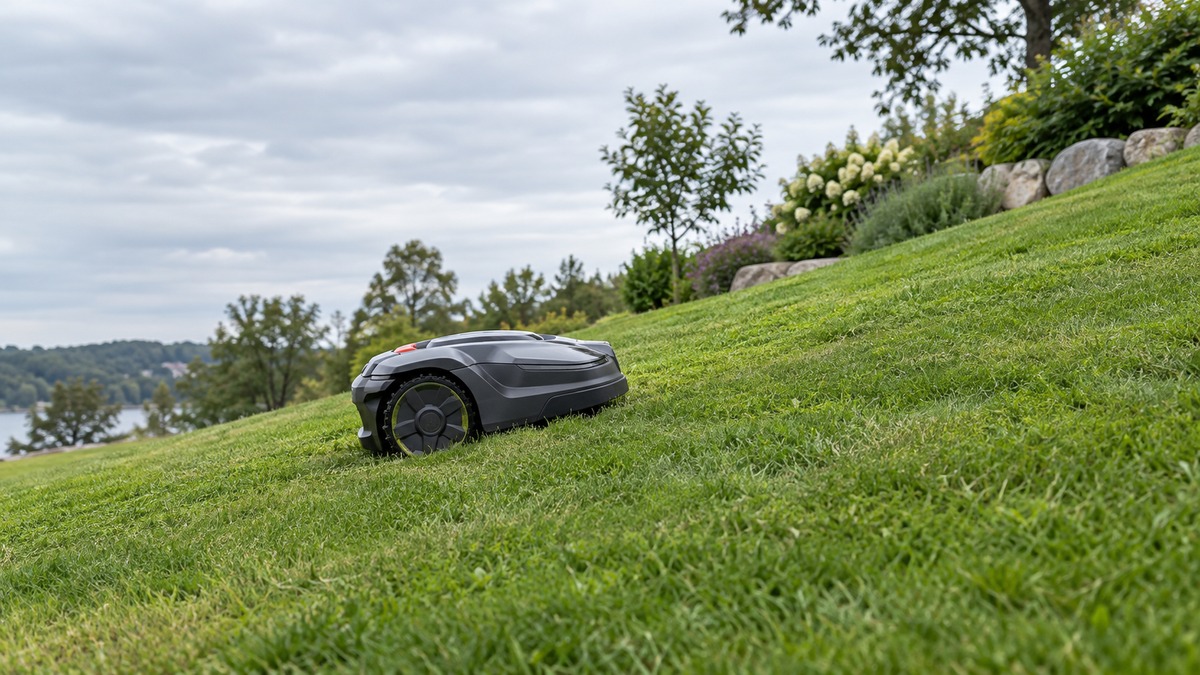
A slope limit is a ratio, not an angle. The Husqvarna steep-slope page gives the formula: slope (%) = vertical height / horizontal distance x 100. Its example is 15 cm (6 in) of rise over 100 cm (40 in) of run, which the page works out as 15%.
The same formula runs in reverse. A 25% limit means the ground rises 25 cm for every 100 cm of horizontal distance. A 70% limit means a rise of 70 cm over the same 100 cm. These two lines are arithmetic from the formula, not figures stated on the page. The Husqvarna page converts its own range to degrees: 25% to 50% is listed as 14 to 26 degrees, and 70% is listed as 35 degrees.
The percentage is a measure of how steep the ground is. It does not tell you how the mower handles wet grass or obstacles on a slope. The Husqvarna pages cover those points separately, as set out below.
Standard models, AWD models and the boundary
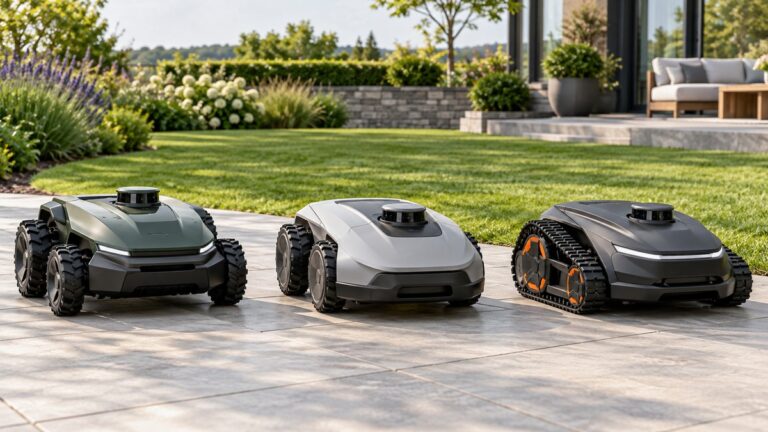
Husqvarna states two ranges in its steep-slope guide. Standard Automower models can manage slopes of 25% to 50%, depending on the model. AWD models such as the 435X AWD and 435X AWD NERA can handle slopes up to 70%. The page asks you to find your model’s maximum slope, so check that figure before you buy. For a smaller yard, see robot mowers for a small lawn.
Work area limit versus boundary limit
The Husqvarna table lists two numbers for each model. The first is “Maximum slope in the work area,” and the second is “Maximum slope by the boundary.” In every row of the captured table, the boundary figure is lower than the work-area figure. Across the table, the gap runs from 10 to 25 percentage points, and it is 20 points for the 435X AWD.
The page explains why the boundary figure matters. It says that slopes in the work area and near the boundaries must not exceed the limits set for the model, and that areas too steep for the mower must be excluded from the installation. The boundary figure is the one that applies near the edge of the lawn.
What the AWD guidance adds
The Husqvarna page gives extra rules for AWD models. On slopes up to 50% inside the work area, the page says the lawn mower will operate normally. For slopes between 50% and 70%, it says to avoid having obstacles on slopes. It also says to maintain 1.5 m (5 ft) from the bottom of the slope to the boundary wire, and to provide at least 50 cm (1.6 ft) of level ground between flat areas and steep slopes. Those distances are the page’s own figures and apply to AWD models.
Husqvarna slope limits by model group
The table lists the Husqvarna model groups as they appear in the captured text. The gap column is the work-area figure minus the boundary figure, in percentage points. The gap is a calculation from the two sourced columns, and the formula is stated here.
| Model group (as captured) | Max slope in work area | Max slope by boundary | Gap (points) | Source |
|---|---|---|---|---|
| Aspire R4 | 25% | 10% | 15 | Husqvarna steep-slope guide (KA-01431) |
| 105 | 25% | 15% | 10 | Husqvarna steep-slope guide (KA-01431) |
| 305E NERA, 310E NERA, 405XE NERA, 410XE NERA | 30% | 20% | 10 | Husqvarna steep-slope guide (KA-01431) |
| 405VE NERA, 410VE NERA | 30% | 20% | 10 | Husqvarna steep-slope guide (KA-01431) |
| 305, 310, 310 Mark II, 315, 315 Mark II, 315X (row cut off in the captured text) | 40% | 15% | 25 | Husqvarna steep-slope guide (KA-01431) |
| Aspire R6V, 308V, 312V | 40% | 15% | 25 | Husqvarna steep-slope guide (KA-01431) |
| 405X, 415X, 420, 430X, 440, 450X | 40% | 15% | 25 | Husqvarna steep-slope guide (KA-01431) |
| 320 NERA, 430X NERA, 450X NERA | 50% | 25% | 25 | Husqvarna steep-slope guide (KA-01431) |
| 430V NERA, 450V NERA | 50% | 25% | 25 | Husqvarna steep-slope guide (KA-01431) |
| 435X AWD, 435X AWD NERA | 70% | 50% | 20 | Husqvarna steep-slope guide (KA-01431) |
Formula for the gap column: gap = work-area figure minus boundary figure. For the 435X AWD: 70 minus 50 equals 20 points. The captured table does not give model names for every line, so match your model’s name against the manual before you use a row.
STIHL iMOW limits
The STIHL iMOW service page says the robotic mowers take on slopes of up to 40% and 45% on the EVO models. Its specification table gives 40% for most models and 45% for the EVO models, with a second figure in brackets, 60%. The captured text does not explain the bracketed figure.
The two upgrade figures disagree. A footnote says the maximum slope on EVO models can be increased to 55% with the Upgrade Kit 10 iMOW. A sentence on the same page says that with the upgrade kit, the EVO can tackle gradients as high as 60%. This post shows both figures and does not choose between them. Check the manual for the exact model and kit before you plan around either number.
Compare the two brands carefully. The STIHL figures are single values without a boundary column, so they cannot be read the same way as the Husqvarna pair. For a broader look at robot models built for uneven ground, see all-terrain robot lawn mowers.
Conditions behind the figures
The Husqvarna slope table gives no conditions for its slope figures. The STIHL specification table has a footnote that reads “Under ideal conditions (few obstacles, simple geometry and low inclines in the garden, moderate lawn growth).” That footnote is attached to the maximum lawn area row, not to the gradient row. The gradient rows carry their own footnote, which covers the upgrade figure only.
So the sources state the figures without saying how they were set. Read a figure with no stated conditions as the maker’s rating. The pages do not say it is a guarantee for a given lawn.
Safety on slopes
The safety points below come from manufacturer and extension pages. Robot-specific points are labelled. Riding and walk-behind points are labelled as general mower guidance.
- Wet grass. The Husqvarna page says steep slopes increase slipping risk, especially in wet conditions. The ag-safety extension page says to avoid mowing wet grass because it is slippery. For more on that topic, see electric lawn mowers used on wet grass.
- Excluded areas. Husqvarna says areas too steep for the mower must be excluded from the installation. The page lists boundary wire islands and, where the model supports it, AIM stay-out zones as the ways to do that.
- Roadside slopes. Where a slope borders a public road, Husqvarna says to install a protective barrier, such as a wall or fence, of at least 15 cm (6 in) along the outer edge.
- Obstacles on slopes. The Husqvarna page says obstacles like trees or rockeries force the mower to turn, which increases slipping risk on steep slopes, and it suggests an irregular mowing pattern or a stay-out zone if the problem persists.
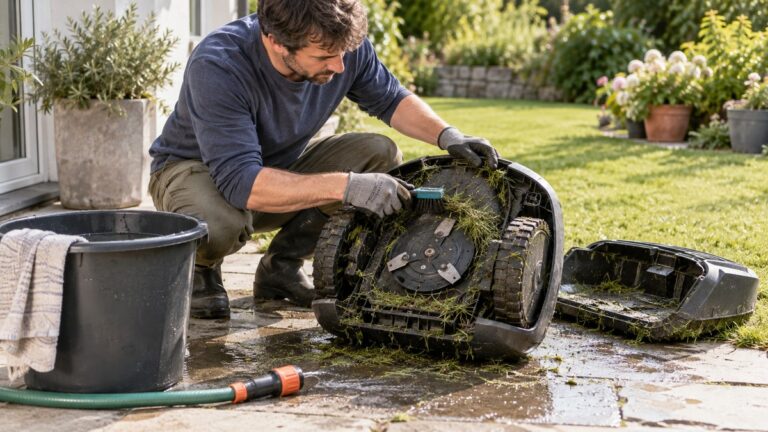
- Traction. The page says slopes become harder to manage if the wheels are clogged with grass, and that most models offer an optional Terrain Kit with heavy rear wheels and wheel brushes.
For riding mowers, the Penn State page says that on a slope greater than 15 degrees, you should drive up and down the slope. The Illinois page says riding mowers should be driven up and down slopes, and never across, while push mowers should mow across the slope. The ag-safety page says riding mowers can overturn on a steep slope or embankment. These are rules for other machines. They do not give a robot’s limit, and the 15-degree figure should not be read as a robot rating.
How we chose
We searched for manufacturer pages that state slope figures and for extension pages on mower safety. We opened six pages on 2026-10-22: two Husqvarna pages (the steep-slope guide and the FAQ), one STIHL iMOW page, and three extension pages. Robot figures come only from the Husqvarna and STIHL pages. The extension pages are cited for general riding and walk-behind rules, and those rules are labelled as such. We quoted sentences that appear in the saved text of each page. This post does not rank models.
What we could not verify
- Which model sits in the row cut off in the captured Husqvarna table, for the group that begins with 305, 310 and 310 Mark II.
- How the figures were measured. The Husqvarna page gives a formula for slope, but neither manufacturer’s pages describe the measuring method.
- Whether the figures change on wet grass. The pages say wet conditions raise slipping risk, but they do not state a lower figure for wet lawns.
- Which STIHL figure applies to a given EVO model, 55% or 60%. The sources disagree, and the captured text does not settle it.
What the sources do not say
- The conditions behind the Husqvarna slope figures, and the conditions behind the STIHL gradient figures.
- Degree equivalents for the STIHL figures. The STIHL pages we opened give percentages only.
- A share of the lawn that can be steep before performance falls. The pages say which areas to exclude, not how much of a lawn can be steep.
- Any robot figure above 70%. The highest Husqvarna figure on the pages we opened is 70%, and the highest STIHL figure is 60%.
FAQ
What does a robot mower slope limit measure?
It measures how steep the ground is, as a ratio of rise to run, multiplied by 100. The Husqvarna steep-slope page gives the formula and an example of 15 cm of rise over 100 cm of run, which is 15%. The limit is the steepest value the manufacturer states, and Husqvarna states one for the work area and one for the boundary.
Is a 25% limit the same as a 25-degree limit?
No. The Husqvarna page converts its 25% figure to 14 degrees, and its 50% figure to 26 degrees. A percentage and a degree are different scales, so check which one a listing uses before you compare two mowers.
Why do the work-area and boundary limits differ?
Husqvarna gives a separate figure for the work area and for the area by the boundary. In every row of its table, the boundary figure is the lower one. The page says that areas too steep for the mower must be excluded from the installation, so the boundary figure is the one to check against the steepest edge of your lawn.
Does a 70% AWD rating mean the mower can handle any 70% slope?
The Husqvarna page sets 70% as the top figure for AWD models, and it adds extra rules above 50%. Those rules say to avoid obstacles on slopes and to keep 1.5 m (5 ft) from the bottom of the slope to the boundary wire. The page does not promise the mower will work on every part of a 70% slope.
Should I use 55% or 60% for a STIHL EVO model?
The STIHL pages disagree. A footnote gives 55% with the Upgrade Kit 10 iMOW, and a sentence gives 60% for the upgraded EVO. The captured text does not say which applies, so check the manual for your exact model and kit.
Are the riding-mower slope rules the same for a robot?
No. Penn State’s 15-degree rule is for riding mowers, and the Illinois direction advice covers riding and push mowers. Neither source gives a robot mower figure, so the robot limit has to come from the manufacturer’s listing or manual.
Bottom line
Check the boundary figure, not only the work-area figure, against the steepest slope along the edge of your lawn. If an edge slope is steeper than the boundary figure, the Husqvarna page says to exclude that area.
Sources
- Husqvarna US Support: Optimising an Automower installation for steep slopes (opened 2026-10-22)
- STIHL: iMOW robotic mowers mow smart (opened 2026-10-22)
- Husqvarna US: Frequently asked questions (FAQs) about Automower (opened 2026-10-22)
- Penn State Extension: Riding Lawnmower Safety Practices (opened 2026-10-22)
- University of Illinois Extension: Maintaining Lawn Equipment (opened 2026-10-22)
- Agricultural Safety and Health (extension.org): Riding Lawnmower Safety (opened 2026-10-22)