How to Check a Mower Blade for Balance
As an Amazon Associate we earn from qualifying purchases.
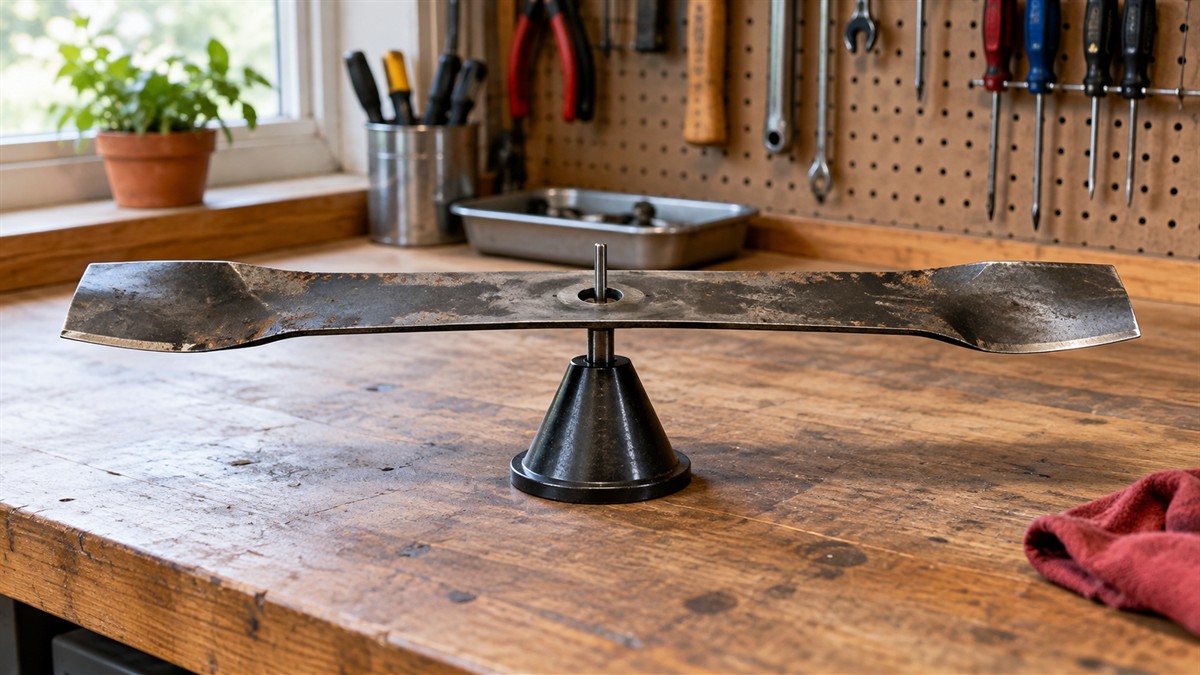
Here is how to check mower blade balance the way the manufacturer pages describe it: hang the blade on a nail through its center hole, or set it on a balancer, and see whether one end drops. If one end drops, the heavy end needs small amounts of metal removed, and then you check again.
The reason is vibration. An unbalanced blade shakes the mower, and that shaking wears the parts it passes through. This guide sets out the method, the points where the sources differ, and when the sources say to check.
Quick answer
- Check balance after you sharpen a blade or fit a new one. Husqvarna says balancing is necessary once blades have been replaced or sharpened.
- Hang the blade on a nail through its center hole or set it on a balancer. If one end drops, the heavy end needs material removed.
- Remove small amounts from the heavy end, recheck, and repeat until the blade rests level with neither end dropping.
- ECHO says the nail check can miss smaller imbalances. The pages we opened give no balance tolerance beyond level.
Why balance matters
ECHO compares a mower blade to a car tire: a blade spinning at high speed has to be balanced to avoid vibration. Even small weight differences between the two ends create forces that grow with rotational speed. Those forces load the spindle bearings, engine mounts and deck components, and they can tire the operator and affect the cut.
Husqvarna’s Australian guide warns that an unbalanced blade can cause intense vibration, which can damage the deck and motor. Husqvarna’s FAQ puts it more briefly: an unbalanced blade will eventually damage the mower or engine. ECHO’s maintenance page adds the positive side, that balanced blades reduce vibration and wear on the bearings and engine.
ECHO also says that even factory-new blades sometimes have balance problems. That is why it treats a balance check after sharpening as essential rather than optional. Properly balanced blades, ECHO adds, make the mower run noticeably smoother.
Safety before you check
Start by cutting power to the blade. ECHO’s product page says to take basic safety precautions before you remove or service a blade, and to remove the battery or key on electric equipment to prevent accidental startup. ECHO’s sharpening guide gives the same order: disconnect the battery, then take the blade off before any sharpening. Husqvarna’s FAQ says the same thing from another angle, telling you to remove the blade first and not to sharpen it while it is on the mower.
Protect your hands as well. ECHO advises cut-resistant gloves whenever you handle blades, and a piece of wood to block the blade while you loosen the mounting bolt. ECHO’s sharpening page also asks you to secure the blade in a sturdy surface or a vise while you work on it. For what the battery specs mean before you handle the mower, see the guide to battery voltage and amp-hour ratings.
What you need
- A balancer or a nail. ECHO describes a purpose-built balancer as a low-friction pivot that shows small weight differences clearly. A nail works too, and Husqvarna says to leave about one inch of the nail exposed. The sources do not give a size for the balancer.
- A file or grinder, only if you plan to remove metal. Husqvarna’s FAQ says a blade can be sharpened with a file or on a grinding wheel once it is off the mower.
- A torque wrench for reinstalling. ECHO says to tighten the bolts to the figure in the operator’s manual, and not to overtighten them.
- Gloves and a block of wood, as covered in the safety section.
Step-by-step balance check
- Cut power and remove the blade. Disconnect the spark plug or battery, then take the blade off the mower. Husqvarna’s FAQ says not to sharpen the blade while it is still on the mower.
- Inspect the blade. Husqvarna’s Australian guide tells you to look for damage first. Signs of damage, cracks or dents mean the blade should be replaced, not balanced.
- Hang or set the blade. Hang the blade by its center hole on a nail, or set it on a balancer. Husqvarna says a balanced blade stays horizontal on the nail.
- Read the result. If one side dips lower than the other, the blade is not balanced, and metal has to come off the heavy end. Husqvarna says that if either end moves downward, the heavy end should be sharpened until the blade balances.
- Remove small amounts from the heavy end. ECHO’s product page says to take metal from non-cutting areas of the heavy side, such as the back edge or upper surface, and to avoid significant changes to the sharpened cutting edge. ECHO’s sharpening page says to grind the top surface only and never the bottom side.
- Recheck and repeat. After each small removal, check the blade again. Keep going until it rests level on the balancer with neither end dropping. ECHO describes this as a repeated cycle of small removals and rechecks.
- Check once more before tightening. Husqvarna’s Australian guide says to check the balance again before the blade is tightened into position.
- Reinstall and tighten to the manual. Use the correct bolts in their original configuration. ECHO says to tighten with a torque wrench to the operator’s manual figure and to avoid overtightening, then double-check that the blade is installed securely.
Adjusting an unbalanced blade
Heat matters when you grind. ECHO warns that a drill attachment or bench grinder heats the blade where it is sharpened. The area must not turn blue, because that can significantly reduce the blade’s strength and hardness.
Keep the cutting edge intact. ECHO says that when you remove metal from the heavy side, you should avoid significant changes to the sharpened cutting edge. Husqvarna’s Australian guide says to start at the heavier end, take small amounts at a time, and sharpen evenly across the face. It also says never to sharpen to a knifepoint and to leave a small edge, which it describes as about 1 mm.
Nail check or balancer: where the sources differ
ECHO treats the traditional nail check as a rough assessment. Friction between the blade hole and the nail hides smaller weight differences, so a level result on a nail does not rule out a smaller imbalance, according to ECHO. A balancer with a low-friction pivot responds to much smaller differences.
Husqvarna’s FAQ presents the nail check as the method to use, and the page we opened does not add ECHO’s caution about sensitivity. The two pages agree on the steps. They differ in how much weight they put on the nail result, so if you have a balancer, use it, and treat a nail result as a first pass.
Sharpen yourself or use a dealer
The sources disagree about home sharpening. Husqvarna’s FAQ says the company does not recommend sharpening a blade, but it also explains how to file or grind one at home, with a balance check afterwards. Husqvarna’s US support page says to let a service centre sharpen and balance the blades. ECHO’s sharpening guide describes home sharpening step by step, and it suggests contacting an ECHO servicing dealer if you are not comfortable with the task, since dealers have professional balancers and grinders.
When to check the balance
The sources name three moments. After sharpening, ECHO recommends sharpening about every 20 to 25 hours of mowing, or once or twice during the mowing season, and checking balance each time. After replacement, Husqvarna’s US page says balance is necessary once blades have been replaced or sharpened, and it warns that a blade not correctly attached after replacement can unbalance. Before tightening, Husqvarna’s Australian guide says to check again before the blade goes back on.
What each source says about the check
The table lists each point beside the page it comes from. A cell that says not stated means the cited pages do not give that detail.
| Point | What the source says | Source |
|---|---|---|
| Nail check | Rough; can miss smaller imbalances | ECHO product page |
| Nail check setup | Leave about one inch of the nail exposed; a balanced blade stays horizontal | Husqvarna FAQ |
| Balancer | Low-friction pivot; heavier end visibly drops | ECHO product page |
| Which side to remove from | Heavy side, non-cutting areas such as the back edge or upper surface | ECHO product page |
| Grinding face | Top surface only; do not grind the bottom side | ECHO sharpening page |
| Starting point and amount | Heavier end, small amounts, sharpened evenly across the face | Husqvarna Australia |
| Stop point | Level, with neither end dropping | ECHO product page |
| Heat | Keep the sharpened area from turning blue | ECHO sharpening page |
| Edge allowance | Do not sharpen to a knifepoint; leave about 1 mm | Husqvarna Australia |
| Check before tightening | Balance again before the blade is tightened | Husqvarna Australia |
| Timing | Every 20 to 25 hours, or once or twice a season | ECHO sharpening page |
| Torque | Not stated; use the figure in the operator’s manual | ECHO sharpening page |
| Balance tolerance | Not stated beyond level with neither end dropping | All cited pages |
When to replace the blade instead
Replace rather than balance when the blade shows cracks, dents or other damage. Husqvarna’s Australian guide says so directly. Husqvarna’s US page adds that a blade that strikes something such as a rock can be damaged, and that damaged blades should be replaced before the mower is used again. ECHO says that if sharpening does not improve the mower’s performance or how long mowing takes, you may need a new blade. For blade options by brand, see the Black and Decker lawn mower blade guide.
How we chose
We looked for manufacturer pages and extension pages that describe a balance check or blade sharpening. Retail parts sellers, general how-to sites and blogs were left out. Six pages are cited, each opened on 2026-10-22 and each quoted from the saved page text. Five are US pages: three from ECHO and two from Husqvarna’s US support site. Husqvarna’s Australian guide is the sixth. It is cited for the inspection step, the starting point for sharpening, the knifepoint allowance and the check before tightening, because the US pages we opened do not describe those points.
What we could not verify
- A balance tolerance. None of the cited pages says how close to level is close enough, beyond level with neither end dropping.
- The size or weight of a balancer, or the nail diameter that works best.
- Whether a balancer and a nail give the same answer on the same blade. ECHO says the nail is less sensitive, but the pages do not compare the two on one blade.
- Any blade type beyond the blades the pages describe.
What the sources do not say
The sources we opened do not give a numeric tolerance, a grinding rate or a number of passes. They say to remove small amounts from the heavy end but do not say how much to remove per pass. They do not give a torque figure, and they point to the operator’s manual instead. They describe only the nail check and the balancer, so a method beyond those two is outside what this post covers.
FAQ
Can I check balance with a nail instead of a balancer?
Yes. The manufacturer pages describe a nail check: hang the blade by its center hole and see whether it stays horizontal. ECHO says that check is rough and can miss smaller imbalances, and it says a balancer is more sensitive. Husqvarna’s FAQ presents the nail check as its method, so treat a level result on a nail as a first pass, not a final answer.
How much metal should I remove?
The sources say to remove small amounts from the heavy end and then recheck. None of them gives a weight or a number of passes. ECHO asks you to avoid large changes to the sharpened cutting edge, and Husqvarna’s Australian guide says to work evenly across the face.
Does a new blade need a balance check?
ECHO says even factory-new blades sometimes show balance issues, so it treats the check as essential after sharpening. Husqvarna’s US page says balancing is necessary after blades are replaced, which covers a new blade fitted to the mower.
Can I use a bench grinder or a drill attachment?
ECHO says both tools heat the blade where it is sharpened, and that the area must not turn blue because that can significantly reduce strength and hardness. ECHO’s sharpening page also says to grind the top surface only. Husqvarna’s FAQ says a blade can be sharpened with a file or on a grinding wheel, after removal from the mower.
Should I sharpen the blade myself or take it to a dealer?
The pages differ. Husqvarna’s FAQ says the company does not recommend sharpening a blade, though it explains how to do it at home. On the dealer side, Husqvarna’s vibration page points readers to a service centre for sharpening, and ECHO describes home sharpening but suggests an ECHO servicing dealer if you are not comfortable with the job.
When should I replace the blade instead of balancing it?
Replace it when there are signs of damage, cracks or dents, as Husqvarna’s Australian guide says. Husqvarna’s US page says damaged blades should be replaced before the mower is used again. ECHO says a new blade may be needed if sharpening does not improve performance.
Bottom line
If one end of the blade drops on a nail or balancer, remove small amounts from the heavy end and recheck. Repeat until the blade rests level with neither end dropping, check it once more before tightening, and tighten to the torque in your manual.
Sources
- ECHO: How to Balance Lawn Mower Blades Properly (opened 2026-10-22)
- Husqvarna US support: Why is there excessive vibration while using my lawn mower? (opened 2026-10-22)
- ECHO: How to Sharpen Lawn Mower Blades (opened 2026-10-22)
- Husqvarna US: Support FAQs (opened 2026-10-22)
- ECHO: Lawn Mower Maintenance Tips (opened 2026-10-22)
- Husqvarna Australia: Lawn Mower Blade Replacement Guide (opened 2026-10-22)