How to Mow a Slope With an Electric Mower
As an Amazon Associate we earn from qualifying purchases.
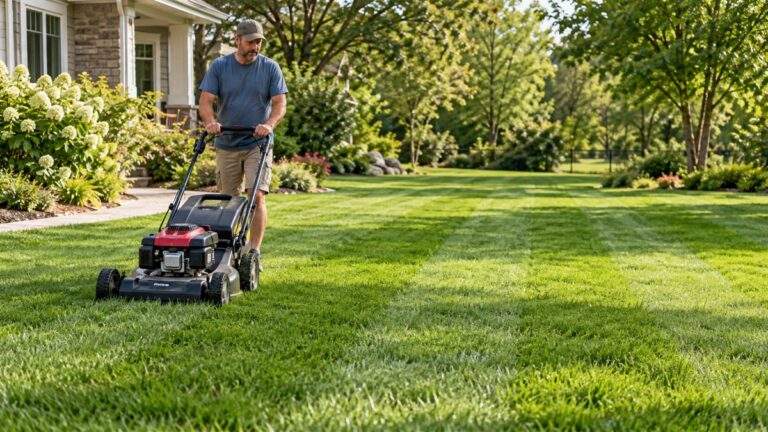
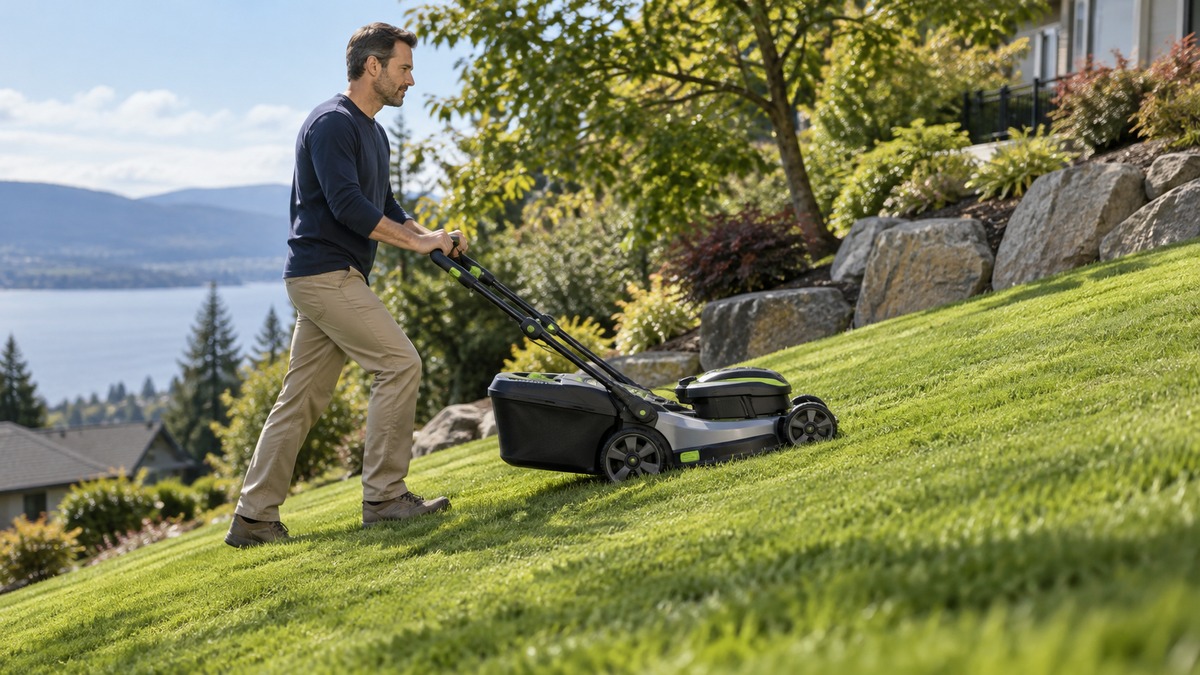
If you need to know how to mow a slope with electric mower, the rule in the walk-behind sources is simple: mow across the slope, from side to side, not up and down. The walk-behind sources also say never to use an electric mower on wet grass and to keep track of the power cord, and OSHA says to stay within the manufacturer’s slope limit. The sources we opened do not give a slope limit for battery walk-behind models, so the figure that applies to your mower has to come from its label or manual.
Quick answer
- Mow a walk-behind electric mower across the slope, side to side, not up and down.
- Riding mowers are the reverse. Their sources say to go up and down, so keep the two rules separate.
- Use the manufacturer’s slope limit from the label or manual. OSHA’s riding-mower page uses 15 degrees only when no limit is given.
- Never use an electric mower on wet grass, and keep track of the cord on a corded model.
Which way to mow: across for walk-behind, up and down for riding
Four of the sources we opened agree on walk-behind direction. Ohio State Extension says: “When mowing on a slope with a push mower, you should mow across the slope.” The extension.org safety page gives the reason: “When using a walk-behind mower, mow across the slope to reduce the risk of contact with the mower blade.” It describes the risk as sliding down the hill and getting your feet caught in the mower. Oklahoma State Extension warns about the uphill pass as well: “mowing up a steep slope could potentially result in the mower sliding back down the slope or running over you if you lose your footing.”
The riding-mower rule is the opposite. Oklahoma State Extension says: “Unlike a push mower that is driven across slopes, riding mowers should be driven up and down slopes.” OSHA’s riding-mower alert is more absolute: “Always mow slopes in the up-and-down direction.” Penn State Extension uses a threshold for riding mowers: “if you are operating a mower on a slope greater than 15 degrees of slope, you should drive up and down the slope.” Those rules are for riding mowers, so do not carry them over to a walk-behind.
| Mower type | Direction the source gives | Source |
|---|---|---|
| Walk-behind push mower, corded or cordless | Across the slope, side to side | Ohio State Extension AEX-591210; extension.org safety page; Oklahoma State Extension teen fact sheet; Oklahoma State Extension 2025 column |
| Riding mower | Up and down the slope | OSHA riding-mower alert; Penn State Extension riding-mower page; extension.org safety page; Oklahoma State Extension teen fact sheet |
| Battery walk-behind model (model-specific manual) | Not stated in the pages we opened | Not stated |
Slope limits: what each source states
The sources give four kinds of figure, and they are not the same thing. The first is the manufacturer’s limit. OSHA says: “Do not operate mowers on slopes that exceed the angle limits specified by the manufacturer.” It adds: “Look for a label on the mower with this information.” The second is a fallback for when no limit is given: “Avoid mowing on slopes with an angle of over 15 degrees if there is no other information available.” That fallback is written for riding mowers. The third is Penn State’s riding-mower threshold of 15 degrees, which sets the up-and-down rule above that slope. The fourth is a planting figure from Iowa State Extension, which is not a mower rating.
| Limit | What the source says | Source |
|---|---|---|
| Manufacturer’s angle limit | “Do not operate mowers on slopes that exceed the angle limits specified by the manufacturer.” | OSHA riding-mower alert |
| 15 degrees, when no limit is given | “Avoid mowing on slopes with an angle of over 15 degrees if there is no other information available.” | OSHA riding-mower alert |
| 15 degrees, riding-mower direction | Above 15 degrees, drive up and down; below 15 degrees, side to side is allowed | Penn State Extension riding-mower page |
| About 30 percent (1:3) | “Those of ~30% (1:3) or more are too steep to mow, and plantings other than turfgrass need to be used.” | Iowa State Extension garden page |
Three of these rows come from riding-mower pages, and the 30 percent figure is a planting guideline. None of them is a rating for a battery walk-behind mower. Penn State’s riding-mower page makes the same point when it says: “make sure you understand the special considerations and safe practices located in the operator’s manual and online.” For your mower, the label and the manual come first.
Measure the slope before you mow
Iowa State Extension explains the measurement: “Slopes are measured by calculating their rise over run.” It gives both forms: “Slope can be expressed as a ratio (such as 1:12, a rise of one foot for every 12 feet) or as a percentage (1:12 = 8.33%).” OSHA suggests a tool if you need one: “Use a slope indicator, also known as a clinometer or inclinometer, if you need one.”
Worked example
Formula: slope in percent = rise ÷ run × 100. Inputs: a bank that rises 1 foot over a horizontal run of 12 feet, which is the same 1:12 example Iowa State Extension uses. Calculation: 1 ÷ 12 × 100 = 8.33 percent. Result: 8.33 percent, matching the source’s own conversion. Compare the result with the limit on your label or manual. If the number is higher than the limit, do not mow that slope. Iowa State writes its 30 percent figure as about 1:3.
Safety before you mow a slope
Most of the safety points below come from Ohio State and Oklahoma State. Each one applies to a walk-behind electric mower, and each has a quoted source.
Wet grass is the first stop. Ohio State Extension says: “Never use an electric mower on wet grass.” Wait until the lawn is dry before you start.
Tip-over is the second. Ohio State Extension says: “A mower can tip over easily.” Its advice for a fall is: “Push the mower away from the body during a fall.” Oklahoma State Extension notes that “Mowing down steep slopes can cause you to lose control of the mower or possibly slip underneath it.”
Power cords are the third. Oklahoma State Extension says: “Cordless electric mowers pose most of the same hazards as gasoline mowers.” It also says: “Corded electric mowers, on the other hand, pose a very large potential threat from electrical shock.” Its advice is: “If you are using an electric mower with a cord, keep track of the cord while you’re mowing.” The 2025 column adds that “Keeping track of the cord while mowing is imperative because the blade can slice through the cord like melted butter.”
Step-by-step: mowing a slope with a walk-behind electric mower
- Read the limit on the label and in the manual. OSHA says to “Look for a label on the mower with this information.” If the label and manual give no figure, use the fallback in the table above and do not assume a higher limit.
- Measure the slope. Use rise over run, as Iowa State Extension describes, or a clinometer or inclinometer, which OSHA suggests if you need one. Skip any section above the limit.
- Check that the grass is dry. Ohio State Extension says: “Never use an electric mower on wet grass.” Do not mow the slope until it dries.
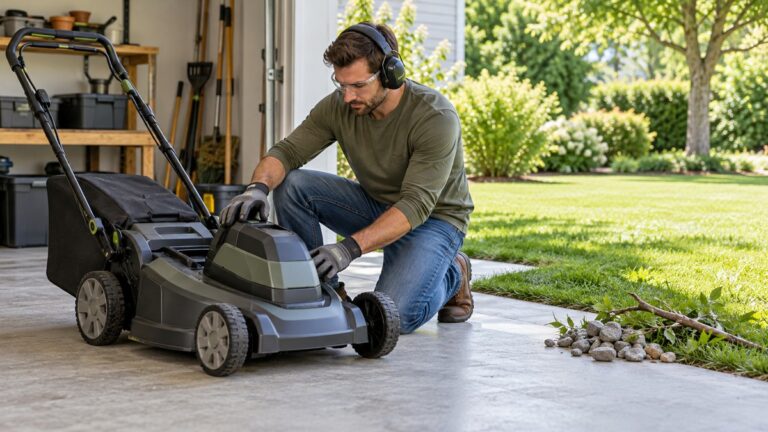
- Set your footing. Ohio State Extension advises: “Start mower from a firm stance with feet in a safe position.” Set your feet before you start the motor.
- Mow across the slope. Work side to side, as Oklahoma State Extension advises: “If you are mowing a yard that slopes, mow across the slope, from side to side, as opposed to up and down the slope.” Mowing across also helps the lawn: “Mowing across slopes also results in a more even mow.”
- Slow down on the descent, and watch the direction. OSHA’s riding-mower alert says: “Decrease speed when the mower is traveling down slopes or around sharp corners to prevent tipping.” The sources we opened do not say whether that speed rule applies to a walk-behind mower.
- Keep the cord clear. On a corded model, keep track of the cord, because the blade can cut through it. This step does not apply to a cordless model, though the cordless hazards are similar to a gasoline mower’s.
- If you fall, push the mower away. Ohio State Extension advises: “Push the mower away from the body during a fall.”
How we chose
We looked for extension pages that name walk-behind mowers or slopes directly, and for OSHA’s hazard alert on slope limits. We opened seven pages on 2026-10-22 and cite all seven. Four of them address walk-behind direction, two are riding-mower pages used to show the contrast, and one is an Iowa State Extension gardening guide that gives a planting figure. We did not rank the sources and did not pick a single best rule. Where the riding and walk-behind pages disagree, we kept them separate.
What we could not verify
The slope limit for your battery walk-behind model. The manuals we found for battery walk-behind models are PDF files, which the fetch method cannot open. This guide does not give a degree or percent limit for any battery model, so check your label and manual.
How a particular deck or wheel layout handles a slope. The pages we opened do not study the handling of any model, so the rules here describe what the sources say, not how a specific machine behaves.
What the sources do not say
None of the pages we opened gives a degree or percent limit for a walk-behind mower. The 15-degree and 30-percent figures are for riding mowers or planting. The sources also do not say whether the downhill speed rule applies to a walk-behind, and they do not give a battery-specific slope rule or a battery-specific wet-weather rule. For mower choices on wet lawns, the electric mower options for wet grass post is the next read. If you are still choosing between mower types for a sloped yard, the pros and cons of electric mowers post lays out the trade-offs, and if your yard is steeper than your walk-behind allows, the all-terrain robot lawn mower post covers a different type of machine.
FAQ
How do you mow a slope with an electric mower?
Mow a walk-behind electric mower across the slope, from side to side, and not up and down. Check the manufacturer’s slope limit on the label or in the manual first. Do not mow a slope that is above that limit, and do not mow wet grass with an electric mower.
Should a walk-behind mower go up and down a slope?
The walk-behind sources we opened say no. Ohio State Extension says: “When mowing on a slope with a push mower, you should mow across the slope.” The riding-mower rule is the opposite, so keep the two separate. Riding mowers go up and down, while walk-behind mowers go across.
What is the steepest slope I should mow?
The sources do not give a steepest slope for a battery walk-behind mower. OSHA says to use the manufacturer’s limit and falls back to 15 degrees for riding mowers when no limit is given. Iowa State Extension says slopes of about 30 percent (1:3) or more are too steep to mow, but that figure is a planting guideline for turf, not a mower rating.
Can I mow a slope with an electric mower if the grass is wet?
No, according to Ohio State Extension, which says “Never use an electric mower on wet grass.” The sources do not say how long to wait after rain, so wait until the grass is dry before you mow a slope.
What should I do about the power cord on a slope?
Keep track of the cord the whole time you mow. Oklahoma State Extension says that “Corded electric mowers, on the other hand, pose a very large potential threat from electrical shock.” Its 2025 column adds that the blade “can slice through the cord like melted butter,” so keep the cord behind you and clear of the path you are cutting.
Bottom line
Use the slope limit printed on your mower’s label or in its manual, and mow any slope within that limit across the grain of the slope, side to side.
Sources
- Ohio State University Extension: Power Lawn Mowers (AEX-591210) (opened 2026-10-22)
- Safety, Health and Wellness in Agriculture (extension.org): Riding Lawnmower Safety (opened 2026-10-22)
- Oklahoma State University Extension: Lawn Care Safety and Basic Maintenance Tips for Teens (opened 2026-10-22)
- Oklahoma State University Extension: Proper Operating Procedures are a must with Lawnmowers (opened 2026-10-22)
- OSHA: Dangers of Roll-Overs of Riding Mowers (opened 2026-10-22)
- Penn State Extension: Riding Lawnmower Safety Practices (opened 2026-10-22)
- Iowa State University Extension and Outreach: Gardening on Slopes and Hillsides (opened 2026-10-22)