How to Store a Hedge Trimmer Between Seasons
As an Amazon Associate we earn from qualifying purchases.
Knowing how to store hedge trimmer between seasons comes down to one routine: let the tool cool, clean and dry the blades, oil the cutting edges, handle the battery or fuel the way your model requires, and keep the trimmer in a dry, protected place with a blade cover on. Husqvarna’s US storage guide and Echo’s storage page describe the same routine with different details. The battery steps below come only from each brand’s own page and are not shared between brands.
Quick answer
- Let the trimmer cool, clean off dirt, leaves and sap, dry the blades, then oil the cutting edges. Husqvarna’s storage guide and its blade-care page give these steps.
- On a battery model, remove the battery and store it indoors in a dry place. Echo’s page adds a temperature range and a full-charge rule for batteries stored longer than six months.
- Store the trimmer in a dry, sheltered place, hung or kept off the ground, with a blade cover fitted.
- Before the next season, inspect the blades and guard, and replace any damaged parts before you use the trimmer.
Why off-season storage matters
Husqvarna’s US storage guide puts the risk in one sentence: cold, moisture, and dirt can damage metal parts and shorten the life of the tool. Most of the steps below deal with one of those three.
The guide lists four common storage mistakes: storing the hedge trimmer dirty, leaving fuel in the tank, keeping it in damp conditions, and forgetting to lubricate the blades. It says these can lead to rust, poor performance, or costly repairs. Each mistake is covered by one of the steps in the routine.
Safety before you start
Storage prep puts you near the blades and the power source, so the safety steps come first. Husqvarna’s storage guide lists wearing protective gloves and disconnecting power, with the battery or spark plug as the power source. It also lists allowing the machine to cool.
- Disconnect power first. Husqvarna’s blade-care guide lists “Disconnect power (battery or spark plug)” before you clean or oil the blades. Echo’s storage page says to remove the battery from the hedge trimmer.
- Wear protective gloves. Husqvarna’s blade-check page lists wearing protective gloves before you check the blades, and its storage guide lists the same gloves before you prepare the tool.
- Keep the guard in place. Husqvarna’s blade-check page lists “The blade guard is securely attached” as a check, and says that “The guard protects you during operation—never use the trimmer without it.”
Step-by-step: the off-season routine
Work through the steps in this order. Each one names the source behind it. Steps 1 to 4 deal with the tool, steps 5 and 6 deal with the fuel and battery, and steps 7 and 8 deal with where it sits.
- Disconnect power and let the machine cool. Husqvarna’s storage guide lists removing the battery on battery models and allowing the machine to cool. Echo’s page lists removing the battery as a storage step.
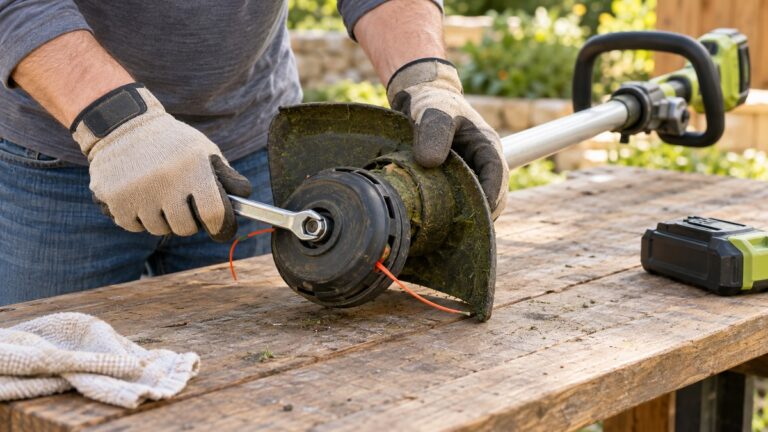
- Clean the whole machine. Husqvarna’s storage guide says to remove dirt, leaves, and sap, and to clean the blades and housing. Its blade-care guide adds that you should brush off leaves, twigs and dirt from the blades. The storage guide notes that dirt and moisture left on the machine can cause corrosion over time.
- Dry the blades. Husqvarna’s blade-care guide says to dry thoroughly and to wipe the blades to prevent rust. It also says moisture left on the blades can lead to corrosion, so this step matters even after a clean.
- Oil the blade edges. The storage guide says to apply oil along the blade edges, which protects against rust and keeps the blades in good condition. The blade-care guide adds to remove any extra oil, because excess oil can attract dirt.
- Empty the fuel tank on petrol models. Husqvarna’s storage guide lists “Drain fuel in petrol models” and says to empty the fuel tank completely. The guide lists leaving fuel in the tank as a common mistake. Battery models do not need this step.
- Store the battery indoors, away from the tool. Husqvarna’s storage guide says to store the battery indoors in a dry place, because cold temperatures can reduce battery life and performance. Echo’s page says to store the battery in a dry, dust-free place, out of the reach of children, and gives the temperature and charge figures covered in the battery section below.
- Pick a dry, sheltered location. Husqvarna says to store the trimmer in a dry, sheltered place such as a garage or shed, and to avoid damp or freezing environments. Echo says to store the unit in a dry, dust-free place, out of the reach of children.
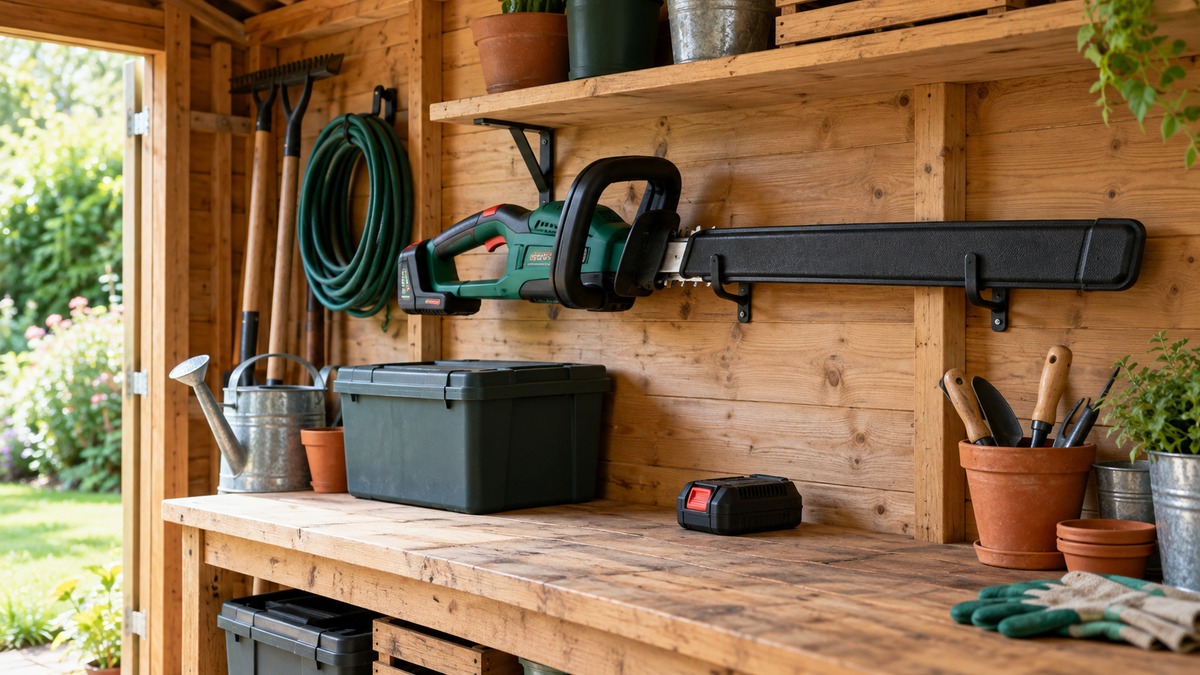
- Hang it or keep it off the ground, and fit a blade cover. Husqvarna says to hang the hedge trimmer or keep it off the ground, and to use a blade cover. It adds that the cover prevents damage and improves safety during storage. Echo says to install the blade scabbard and to cover the battery compartment.
Battery storage: what the sources say
The Husqvarna US storage guide gives no temperature range for its batteries. It says to store the battery indoors in a dry place, because cold temperatures can reduce battery life and performance. That is the Husqvarna storage advice for the battery that this guide uses.
Echo’s storage page is the only source here with figures. For Echo batteries, it gives a storage range of -4°F (-20°C) to 140°F (60°C). It also says that if the battery is stored for longer than six months, you should charge it to 100% capacity, and it says to remove the battery from the charger before storage. These figures are Echo’s, for Echo batteries. This guide does not apply them to any other brand, and the battery manual for your model is the source to check.
For battery and charger options, see this site’s guides to Worx hedge trimmer battery and charger options and Black and Decker hedge trimmer battery and charger options. This guide does not cover battery repair or any internal battery part, and no step here asks you to open a battery.
Storage checklist by source
The table lists what each source states. A cell that says “not stated” means that source did not cover the point. Use it to match the steps to your model: the Husqvarna column covers its battery and petrol models, and the Echo column covers Echo’s battery figures.
| Item | Husqvarna US storage guide (KA-70198) | Echo storage page | Source |
|---|---|---|---|
| Power step | Disconnect power (battery, or spark plug) | Remove battery from hedge trimmer. | Husqvarna KA-70198; Echo storage page |
| Cool first | Allow the machine to cool | Not stated | Husqvarna KA-70198 |
| Blades | Apply oil along the blade edges | Not stated | Husqvarna KA-70198 |
| Fuel, petrol models | Empty the fuel tank completely | Not stated | Husqvarna KA-70198 |
| Battery location | Store the battery indoors in a dry place | Store in a dry, dust-free place, out of the reach of children. | Husqvarna KA-70198; Echo storage page |
| Battery temperature | Not stated | Store in temperatures between -4°F (-20°C) and 140°F (60°C) | Echo storage page |
| Battery stored over six months | Not stated | Charge to 100% capacity | Echo storage page |
| Trimmer location | Store in a dry, sheltered place (garage or shed) | Store unit in a dry, dust-free place, out of the reach of children. | Husqvarna KA-70198; Echo storage page |
| Hang or off the ground | Hang the hedge trimmer or keep it off the ground | Not stated | Husqvarna KA-70198 |
| Blade cover | Use a blade cover | Install blade scabbard. | Husqvarna KA-70198; Echo storage page |
| Battery compartment | Not stated | Cover battery compartment of hedge trimmer. | Echo storage page |
A worked check for the six-month rule uses the date you put the battery away. For example, a battery put away on 22 October reaches six months on 22 April. The Echo rule applies to storage longer than six months, so the full-charge step is due if the battery is still in storage after 22 April. The formula is the storage date plus six months, and the input is the date. The result applies to Echo batteries only.
Before the next season
Before you use the trimmer again, check the blades and guard. Husqvarna’s blade-check page says to inspect before each use, check the blades for dull edges or uneven wear, and replace worn or damaged parts. It also says “Damaged blades should be replaced before use.” Check the blade guard as well, because the page’s check list includes “The blade guard is securely attached.”
Husqvarna’s blade-care guide adds one more check: if the trimmer still cuts unevenly, tears branches, or feels less effective after cleaning, “The blades may need sharpening instead.” That check is worth making at the start of the season.
Common mistakes to avoid
- Storing the hedge trimmer dirty. The storage guide lists this first. Clean the tool before it goes away.
- Leaving fuel in the tank. On petrol models, the guide says to empty the tank completely.
- Keeping it in damp conditions. The guide says moisture can cause rust, and that cold can damage components.
- Forgetting to lubricate the blades. The storage guide says oil along the blade edges protects against rust.
- Leaving moisture on the blades. The blade-care guide lists this as a common cleaning mistake.
- Waiting too long between cleanings. The blade-care guide lists this too, and it says to clean the blades after each use.
How we chose
We chose manufacturer support pages, with US pages first. We opened four pages on 2026-10-22: three Husqvarna US support pages and one Echo support page. Echo is a different brand, so its page is used only for the battery temperature range, the six-month charge rule, the blade scabbard, and the battery compartment cover. We also opened a Ryobi help page for a hedge trimmer attachment, which did not cover storage, so it is not cited.
We did not rank the sources, and we did not treat one brand as more reliable than another. Manuals for other brands that came up in the search were PDF files, which this tool cannot open, so this guide does not quote them.
What we could not verify
The Husqvarna storage guide gives no battery temperature range, and it gives no rule for how long a battery can sit before it needs charging. The Echo figures are the only numbers in this guide, and they belong to Echo. Other brands may differ, so check the battery manual for your model before you use any temperature or charge rule.
The sources do not say whether a trimmer should be stored with the battery in or out in every case. They say to remove the battery in the storage steps, and they say to store it indoors, which is what this guide follows. Winter conditions in your area may differ from the conditions these pages assume, and the pages do not describe a climate.
What the sources do not say
- Which oil or lubricant to use on the blades. Husqvarna says to apply oil and does not name a type.
- How long the trimmer can sit before first use, or whether it needs running before next season.
- Storage steps for corded hedge trimmers. The pages opened for this guide describe battery and petrol models.
- How to remove the blade for storage, or whether it should be removed at all.
- Whether a blade cover is required, or how it should fit. Husqvarna says to use one and Echo says to install a blade scabbard.
FAQ
Should I remove the battery before I store my hedge trimmer?
Yes, according to both sources in this guide. Husqvarna’s storage guide lists removing the battery on battery models, and Echo’s page lists it as a storage step too. After you remove it, store the battery indoors in a dry place.
Echo gives a temperature range of -4°F (-20°C) to 140°F (60°C) for its battery storage. Husqvarna does not give a range. Check the manual for your own battery before you store it.
Should I oil the blades before storing the trimmer?
Yes. Husqvarna’s storage guide says to apply oil along the blade edges, which protects against rust and keeps the blades in good condition. Its blade-care guide adds that you should remove any extra oil, because excess oil can attract dirt.
Clean and dry the blades before you oil them. The blade-care guide says to dry thoroughly and wipe the blades to prevent rust, and it says moisture left on the blades can lead to corrosion.
Do I need to drain the fuel before storage?
On a petrol model, yes. The storage guide says to empty the fuel tank completely before storage.
Battery models skip this step. The fuel instruction appears only for petrol models, so a battery trimmer follows the battery steps instead.
Where should I keep the hedge trimmer during the off season?
Husqvarna says to store the trimmer in a dry, sheltered place, such as a garage or shed, and to avoid damp or freezing environments. It also says to hang the trimmer or keep it off the ground. Echo’s page adds a dust-free spot that is also out of children’s reach.
What does a blade cover do during storage?
Husqvarna says to use a blade cover, and that this prevents damage and improves safety during storage. Echo’s storage page says to install the blade scabbard, which covers the blade for the same purpose. Fit the cover after the blades are cleaned, dried and oiled.
Do I need to check the trimmer before using it again?
Yes. Husqvarna’s blade-check page calls for an inspection before each use. It also says damaged blades should be replaced before use, and it lists the blade guard as securely attached.
Bottom line
Clean, dry and oil the blades, remove the battery and store it indoors, then keep the trimmer dry, off the ground and under a blade cover. Use a brand’s battery temperature or charge rule only for that brand’s battery.
Sources
- Husqvarna US: How to store a hedge trimmer for winter, prevent rust and damage (opened 2026-10-22)
- Husqvarna US: How to clean and oil hedge trimmer blades (opened 2026-10-22)
- Husqvarna US: Is your hedge trimmer safe to use? Check blades and guard (opened 2026-10-22)
- Echo: Storage, Hedge Trimmers (opened 2026-10-22)