Keeping Kids and Pets Clear of the Mower
As an Amazon Associate we earn from qualifying purchases.
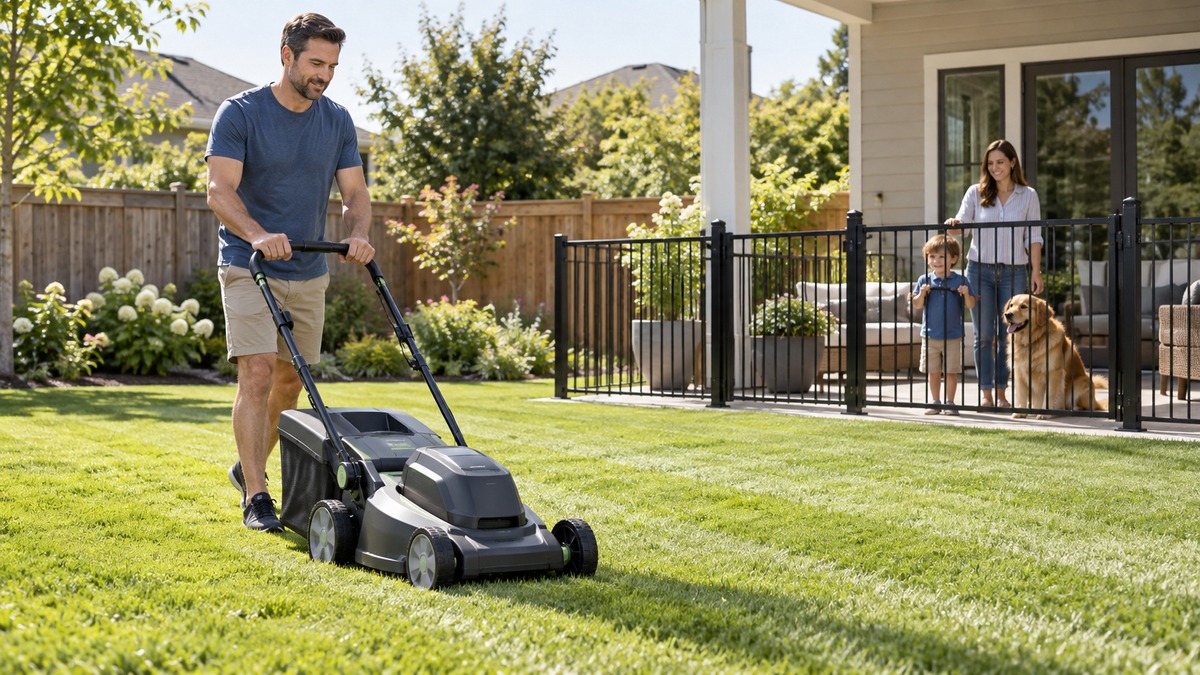
Keeping kids and pets clear of the mower starts before the engine does. Put pets and little children inside, walk the yard for toys and other objects, and keep a clear zone that no one enters while the machine runs. This guide covers those steps for mowers and trimmers, using safety pages we opened on 2026-10-22.
Children and animals can be hit by thrown objects, and a reversing riding mower can run over a child, and the sources differ on some details. Where they do, this guide says so.
Quick answer
- Put pets and little children inside before you start the mower.
- Keep everyone out of a 75-foot zone around the mower, and clear the yard of toys, bones and balls first.
- Point the discharge away from people and pets, and never let a child ride along on a mower.
- Check behind you before you back up, and do not mow where young children are playing.
Safety before the first pass
Mowers and trimmers throw things. Oklahoma State University states the risk plainly: “Before operating a lawn mower, be sure to put pets or little children inside and avoid working near people, as objects and dust thrown by equipment can irritate or harm others.” Ohio State gives the same warning in a shorter form: “Foreign objects can fly from the mower, so make sure the mowing area is clear of people, animals, litter, and debris.” These two statements drive the rest of this guide.
Thrown objects can also come back at you. Oklahoma State adds: “Remember that thrown objects can also ricochet and cause injury or damage.”
Why children and pets are at risk
Penn State Extension’s riding-mower page gives the scale of the problem: “There are approximately 10,000 mower injuries to children/youth each year, and about 5% of those injuries result in an amputation.” The page gives that figure as approximate, and it refers to children and youth rather than animals.
eXtension’s Ag Safety page explains why young children need their own rule. It says the operator “may not be able to hear them approaching the machine.” For pets, the sources we opened say to keep animals out of the area and off the discharge path.
Distance and the clear zone
Oklahoma State recommends that you “make sure no one is within 75 feet while operating a mower.” Seventy-five feet works out to about 22.9 meters, using 75 × 0.3048 = 22.9. The distance is a typical figure in one source, so keep the zone for the whole session and check your manual for anything it says on distance. If you are weighing corded against cordless models, the pros and cons of electric mowers guide covers the tradeoffs.
Oklahoma State advises putting pets and little children indoors before the machine runs, which is the first step in the list below.
Steps to keep children and pets clear
Follow these steps in order. Each one names the source behind it.
- Put pets and little children inside before you start. This is the first step in the list, and it comes before any yard check.
- Set the 75-foot zone and keep it while the mower runs. Oklahoma State’s guidance is to make sure no one is within that distance while the mower operates.
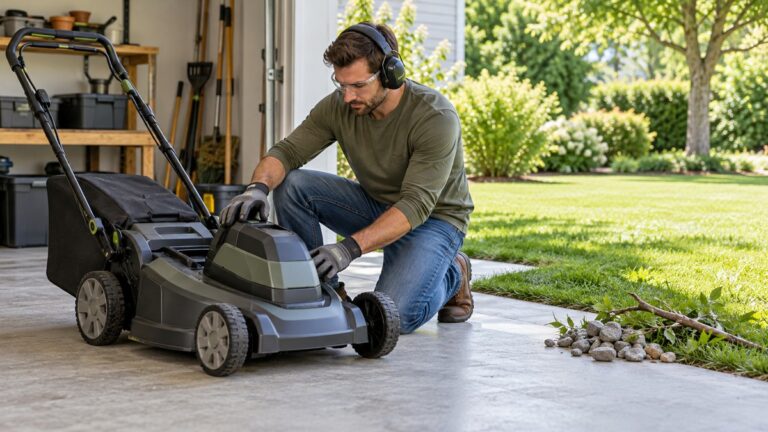
- Walk the yard and clear the objects. Oklahoma State says: “If children and pets are routinely in the yard, also be sure to check for and remove toys, bones, balls or other objects that might be tripped over or thrown during mowing.” Penn State says to “Clear the area of any sticks, rocks, toys, or other debris.”
- Point the discharge away. eXtension says: “Never point the mower discharge chute toward people, pets, homes, structures, streets, or vehicles.” Oklahoma State adds that the discharge should point away from people and pets “who shouldn’t be in the area.”
- Check behind you before you back up. Penn State says: “When mowing, always check behind you for children and others before backing up.” eXtension describes a runover as the case where the operator “does not look behind the mower when backing up on a riding lawnmower and accidentally runs over a child.”
- Do not mow near young children at play. eXtension says: “Do not mow in an area where young children are playing because they may not understand the dangers of the mower and the operator may not be able to hear them approaching the machine.”
- Clear the trimmer area before you start. The trimmer step is in the next section, and it applies before you start the trimmer, not only the mower.
Trimmers, edgers and blowers
The same rules apply to trimmers and edgers. Oklahoma State says that “The major hazard with string trimmers and edgers is two-fold: objects getting launched outward by the trimmer string or edger blade, and the trimmer string or edger blade itself breaking and flying out.” Before you begin, make sure children and pets are not in the area, and keep watch for people passing by. For choosing a trimmer in the first place, see the electric string trimmer guide.
Leaf blowers are a different case, because the hazard runs toward others. Oklahoma State says the “primary hazard of leaf blowers is not directed towards the operator, but rather towards any bystander.” It adds that the equipment can dislodge “small rocks, nuts, bean pods and other debris,” and warns that “These objects can injure people, animals and delicate plants or objects.” If someone walks past while you blow, Oklahoma State advises that you “lower the blower and point it away from them.” If you are choosing a blower, the cordless leaf blower guide compares the options.
Riders and children
Penn State Extension says: “To keep everyone safe, children younger than 14 years of age should not operate riding lawnmowers.” Its rule for riders is short: “One seat. One rider. No exceptions!” Oklahoma State is just as direct: “Remember that it’s never safe to let a child ride on the mower with you, even with the blades disengaged.” Ohio State adds: “No extra riders on self-propelled mowers.”
Who is at risk and what to do
The table sets out each group, the risk as the source states it, and the step that follows from it. Cells paraphrase the source and do not quote it in full.
| Who | Risk stated by the source | What to do | Source |
|---|---|---|---|
| Pets | Objects and dust thrown by equipment can irritate or harm others | Put pets inside before starting | Oklahoma State |
| Little children | The operator may not hear a child approaching | Do not mow where young children are playing | eXtension Ag Safety |
| Bystanders near a mower | Foreign objects can fly from the mower | Clear the area of people, animals, litter and debris | Ohio State, Ohioline |
| Children and pets near a trimmer | Objects can be launched outward by the string or blade | Make sure children and pets are not in the area before you begin | Oklahoma State |
| Passersby near a blower | The main blower hazard is toward bystanders | Lower the blower and point it away from people | Oklahoma State |
| A child on a riding mower | Children under 14 should not operate a riding mower | Keep children off, and carry one rider only | Penn State Extension |
| Backing up | Runovers happen when the operator does not look behind | Check behind you for children before backing up | eXtension Ag Safety; Penn State Extension |
How we chose
We opened four pages on 2026-10-22: Oklahoma State University’s teen fact sheet, Ohio State’s Ohioline mower fact sheet, Penn State Extension’s riding-mower page and eXtension’s riding-mower page. All four are university or extension pages, and we did not use any retail or forum page. The Penn State address we first tried redirected to the riding-mower page, and we cite the final address. CPSC pages returned HTTP 403, so CPSC is not a source in this post.
Two of the four pages are written for teens or for riders. We give their child and rider rules as the sources state them, and we do not extend them beyond what each page says. We did not rank the sources.
What we could not verify
The sources we opened give the 75-foot figure for mowers only. They do not set a clear zone for trimmers, edgers or blowers, so the trimmer and blower steps use the qualitative rules above rather than a distance.
The sources do not give an age below which a child may be near a walk-behind mower, and they do not give an age for trimmers. Penn State’s age rule of 14 applies to riding mowers.
What the sources do not say
- None of the four sources gives a waiting time before children or pets may return to a yard after mowing.
- The sources we opened do not say how far a child should stay from a trimmer or edger.
- None of them gives steps for a pet that runs toward a machine, so the pet steps here are limited to keeping animals inside, out of the discharge path and out of the area.
FAQ
Where should my dog stay while I mow?
Oklahoma State advises that you “put pets or little children inside” before you operate a mower. The pages we opened do not give pet-specific steps beyond that, so keep your dog inside before you start, and keep animals off the discharge path.
How far away should children stand while I mow?
Oklahoma State recommends making sure “no one is within 75 feet while operating a mower,” which is about 22.9 meters. eXtension adds that you should not mow where young children are playing, because they may not hear the machine approach.
Can my child ride along on the mower with me?
No. Oklahoma State says it is “never safe to let a child ride on the mower with you, even with the blades disengaged.” Penn State says children younger than 14 should not operate riding lawnmowers, and its rule for riders is “One seat. One rider. No exceptions!”
Do I need to check the yard for toys before every mow?
Yes, and the sources support checking each time. Penn State says to “Clear the area of any sticks, rocks, toys, or other debris.” Oklahoma State says that if children and pets are routinely in the yard, you should check for and remove toys, bones and balls.
What should I do when someone walks past while I trim or blow?
For a trimmer, Oklahoma State says to “Keep an eye out for passersby” and to make sure children and pets are not in the area before you begin. For a leaf blower, it advises that, if people are walking past, you “lower the blower and point it away from them.”
Can thrown objects hurt people or animals some distance away?
Yes. Ohio State says “Foreign objects can fly from the mower, so make sure the mowing area is clear of people, animals, litter, and debris.” Oklahoma State adds that “thrown objects can also ricochet and cause injury or damage.”
Bottom line
Start the mower or trimmer only when pets and young children are inside or well away, and when no one is within 75 feet of a mower.
Sources
- Oklahoma State University Extension: Lawn Care Safety and Basic Maintenance Tips for Teens (opened 2026-10-22)
- Ohio State University Extension (Ohioline): Power Lawn Mowers (opened 2026-10-22)
- Penn State Extension: Riding Lawnmower Safety Practices (opened 2026-10-22)
- eXtension Safety, Health and Wellness in Agriculture: Riding Lawnmower Safety (opened 2026-10-22)